
In fly fishing, one cast done well beats ten done poorly. Whether you’re lifting line from the water for a new presentation or delivering a fly accurately at range, the overhead cast—and its close cousin, the pick-up and lay-down—is the foundation everything else is built.
This article breaks a single cast down using the Five Essentials of Fly Casting, shows how to keep tight, efficient loops on both the back cast and the forward delivery, and gives you clear faults and fixes you can apply immediately on the grass or water.
What Is the Overhead Cast / Pick-Up & Lay-Down?
The overhead cast is a straight-line casting stroke where the rod tip travels back and forth on a controlled vertical plane.
The pick-up and lay-down is simply one overhead cast used to lift the line from the water and place it back down accurately—no false casting required.
It is:
- The most efficient cast in fly fishing
- The best cast for accuracy and control
- The reference point for diagnosing all casting problems
If your overhead cast is clean, everything else becomes easier.
The Five Essentials Applied to One Perfect Cast
1. No Slack Line
Slack kills the loop shape before the cast even begins.
What to do
- Start with the line straight on the water
- Smoothly lift into the back cast—don’t rip it off the surface
- Maintain light tension throughout the stroke
Key thought: Connection before power.
2. Straight-Line Rod Tip Path
Tight loops come from a rod tip that travels as straight as possible.
What to do
- Keep the rod tracking straight, not arcing sideways
- Use a vertical or slightly canted casting plane
- Think “draw a line with the rod tip.”
Key thought: The loop follows the rod tip.
3. Correct Power Application
Power should be smooth and progressive, not sudden.
What to do
- Start slow, accelerate smoothly
- Apply peak power late in the stroke
- Stop the rod crisply
Key thought: Smooth to fast — not slow to violent.
4. Proper Timing
Timing is about waiting for the loop to straighten—not counting seconds.
What to do
- Watch or feel the back cast
- Begin the forward cast only when the line has nearly straightened
- Adjust timing automatically for longer or shorter lines
Key thought: Let the line tell you when to go.
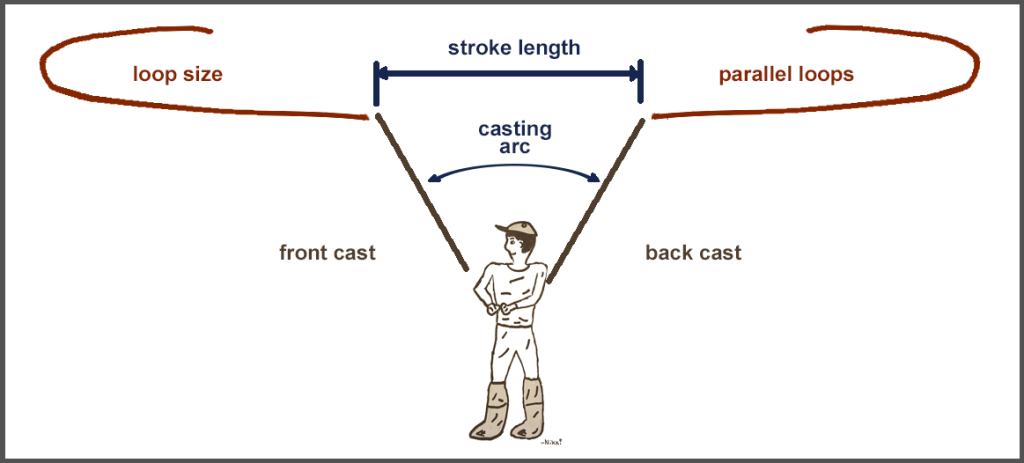
5. Correct Casting Arc
The casting arc must match the amount of line outside the rod tip.
What to do
- Short line = narrow arc
- Long line = wider arc
- Adjust the arc before adding power
Key thought: More line needs more space.
Keeping Loops Tight on Both Back Cast and Forward Cast
A common mistake is focusing only on the delivery cast. Your forward loop can only be as good as your back cast.
To keep loops tight in both directions:
- Match power and arc in each stroke
- Use the same crisp stop behind you as in front
- Keep the rod tracking identical back and forward
If the back cast opens up or tails, the forward cast will suffer—even if it looks powerful.
Common Faults and How to Fix Them
❌ Wide, Open Loops
Cause
- Too wide an arc
- Too much power too early
Fix
- Narrow the arc
- Delay power until late in the stroke
- Focus on a clean stop
❌ Tailing Loops
Cause
- Sudden power application
- The casting arc is too small for the amount of line
Fix
- Smooth out the acceleration
- Widen the arc slightly
- Slow down and feel the rod load
❌ Cracking or Snapping Flies
Cause
- Abrupt stop with Slack
- Poor timing on the forward cast
Fix
- Eliminate slack before the stroke
- Wait longer on the back cast
- Smooth the transition
❌ Collapsing Forward Cast
Cause
- Weak back cast
- Rod tip dipping at the stop
Fix
- Strengthen the back cast first
- Maintain rod tip height
- Stop the rod cleanly
❌ Line Piling Up on Delivery
Cause
- No follow-through
- Casting too low
Fix
- Lower the rod after the loop unrolls
- Allow the line to straighten fully
A Simple Practice Drill (Grass or Water)
- Lay out 30–35 feet of line
- Make one back cast
- One forward cast
- Stop and reset
No false casting.
No rushing.
Just one perfect cast at a time.
This drill exposes faults instantly—and fixes them just as quickly.
Why This One Cast Matters More Than Anything Else
The overhead cast is not basic—it’s fundamental.
Every roll cast, spey cast, curve cast, and distance cast relies on:
- Loop control
- Rod tip control
- Timing
- Power discipline
Master this cast, and fly casting becomes calm, efficient, and repeatable—exactly what fishing demands.
Final Thought
Find a qualified casting instructor to keep you right
Fly casting excellence doesn’t come from complexity.
It comes from doing simple things perfectly, over and over again.
One cast.
Five essentials.
Total control.
Tight lines.
Recent Comments