
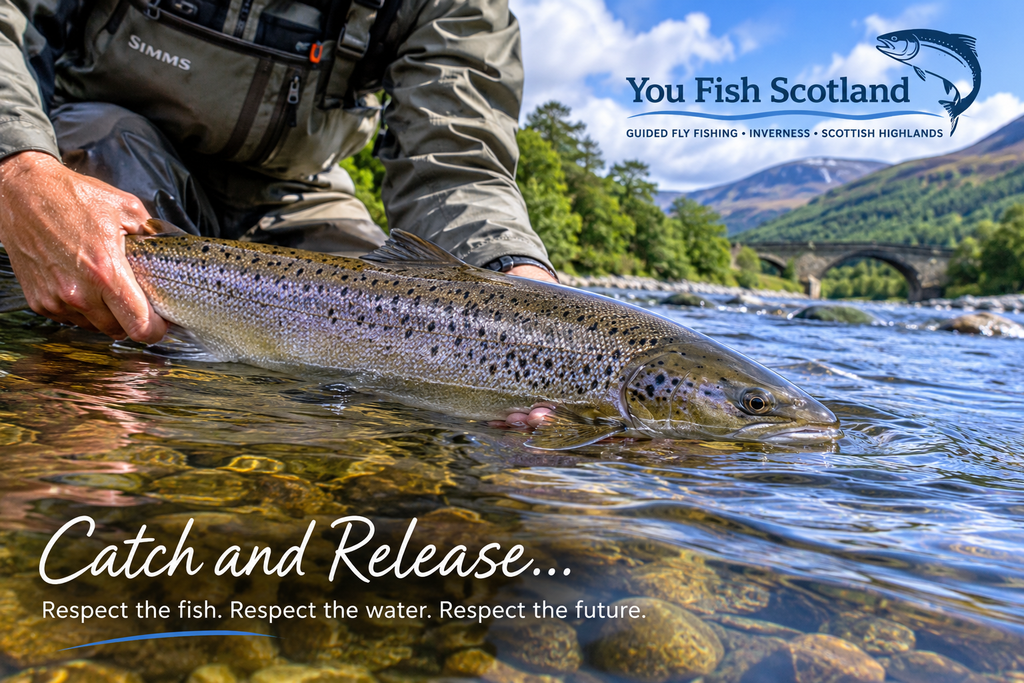
By Wes Grant-Parke | You Fish Scotland
Why responsible fish handling matters more than ever
There is something truly special about catching a wild fish on a fly. Whether it is an Atlantic salmon from the River Ness, a sea trout from the River Spey or a beautiful wild brown trout from a remote Highland stream, every encounter is a privilege.
For many anglers, catching a fish is the highlight of a fishing day. The excitement of the take, the first run, the bend in the rod, and the moment the fish comes within netting distance are experiences that stay with us.
But there is another part of fishing that deserves just as much attention: what happens after the fish is caught.
At You Fish Scotland, we believe that being a responsible angler involves considerably more than knowing how to cast a fly or select the right pattern. It means understanding fish welfare, handling fish correctly and recognising our responsibility towards the wild fish populations that make Scotland such an exceptional fishing destination.
Catch and release is not simply about returning a fish to the water. It is about giving that fish the best possible opportunity to survive, recover and continue its natural life cycle.
Scotland’s changing approach to catch and release
Scotland has a long and internationally recognised tradition of game fishing. Its rivers and lochs support important populations of Atlantic salmon, sea trout and wild brown trout.
However, wild fish populations face increasing pressures, including changes in water temperature, habitat degradation, pollution and wider environmental challenges.
Atlantic salmon populations, in particular, have experienced significant declines.
According to Fisheries Management Scotland, more than 95% of rod-caught wild Atlantic salmon are now returned to Scottish rivers. This demonstrates how significantly attitudes towards conservation and responsible angling have developed.
However, returning a fish does not automatically guarantee its survival.
The way a fish is played, landed, handled, photographed and released can all influence its chances of recovery.
This is why modern catch-and-release practices need to be based on evidence, education and a genuine commitment to fish welfare.
1. Choosing the correct fishing tackle
Responsible fish handling begins before the first cast.
Using appropriately balanced fishing tackle is essential. Fishing with equipment that is too light can result in unnecessarily prolonged fights, leaving fish exhausted before they are landed.
This is particularly important when targeting Atlantic salmon and larger sea trout.
A suitable rod, reel, fly line and leader should allow an angler to maintain control and bring a fish to the net efficiently without applying unnecessary pressure.
Other important considerations include:
- Use appropriately strong leaders and tippets.
- Consider barbless or de-barbed hooks.
- Carry suitable forceps for hook removal.
- Use a soft, knot-less landing net.
- Have a line cutter readily available.
- Avoid tackle that increases the likelihood of deep hooking.
The objective is straightforward: reduce the time a fish spends fighting and minimise the potential for injury.
2. Keeping the fish in the water
One of the most important principles of responsible catch and release is minimising the time a fish spends out of the water.
Fish are adapted to breathe underwater. Although a fish may appear healthy when briefly lifted for a photograph, exposure to air can create additional physiological stress.
Current Scottish catch-and-release guidance strongly encourages anglers to keep fish submerged throughout landing, unhooking and release wherever possible.
At You Fish Scotland, we believe the photograph should never become more important than the welfare of the fish.
If a photograph is wanted, prepare the camera beforehand and aim for an underwater image or a quick photograph with the fish remaining submerged.
A memorable photograph is wonderful, but it should never come at the expense of the fish.
3. Handling fish correctly
Fish have a protective mucus layer covering their bodies. This natural coating provides an important barrier against parasites, infections, and other potential damage.
Dry hands, rough surfaces and unsuitable landing nets can damage this protective layer.
If handling is unavoidable:
- Wet your hands thoroughly before touching the fish.
- Support its body gently and horizontally.
- Avoid squeezing or applying pressure to the abdomen.
- Never touch the gills or eyes.
- Avoid placing the fish on grass, gravel, or dry riverbanks.
- Keep handling time to an absolute minimum.
Where possible, remove the hook while the fish remains in the water, using suitable forceps.
If a hook is deeply embedded and removal is likely to cause further injury, cutting the leader close to the hook may be the better option.
Knowing when not to interfere is an important part of responsible fish handling.
4. Water temperature and fish welfare
Water temperature is another important consideration that anglers should understand.
Fish are particularly vulnerable when water temperatures rise, and dissolved oxygen availability becomes more limited.
A fish that might recover relatively well following capture in cool conditions may experience considerably greater physiological stress in warmer water.
This is particularly relevant during the warmer summer months when Scottish rivers can experience prolonged periods of low water and elevated temperatures.
Responsible anglers should consider:
- Current water temperatures.
- Water levels and flow.
- The time of day.
- The species being targeted.
- Local fishery guidance and restrictions.
There are circumstances when the most responsible decision is to stop fishing altogether.
A professional guide should be prepared to change the day’s plans when conditions become unsuitable for responsible angling.
Catching another fish should never take priority over protecting the fish already in the water.
5. Allowing a fish to recover properly
Releasing a fish is not necessarily the end of the process.
After being played and landed, a fish may need time to recover before swimming away.
Where necessary, support the fish gently in clean, well-oxygenated flowing water, keeping it upright and facing into the current.
Allow water to pass naturally over its gills.
Do not force the fish backwards and forwards through the water, and do not repeatedly handle it to see whether it is ready.
Patience is important.
Allow the fish to regain its strength and leave under its own power.
A strong, controlled departure is a much better indication of recovery than simply allowing an exhausted fish to disappear downstream.
6. The importance of responsible photography
Social media has changed the way anglers share their fishing experiences.
Photographs and videos allow people from around the world to appreciate Scotland’s rivers, salmon and wild brown trout.
However, there is a responsibility that comes with sharing these moments.
A photograph should demonstrate good fish-handling practice rather than encourage unnecessary handling.
Before attempting to photograph a fish, consider whether the image is really necessary.
Prepare your camera, keep the fish submerged, and avoid lifting it into the air for extended periods.
Remember that a fish swimming away safely is a far greater achievement than a photograph sitting on a phone.
7. Professional guides have a responsibility to lead by example
This is an area where I believe professional fishing guides have a particularly important role.
A guide is not simply someone who takes guests fishing. A professional guide should also be an educator, an ambassador for responsible angling, and someone who demonstrates good practice throughout the day.
With 18 years of full-time professional guiding experience, I have always believed that the quality of a fishing experience should be measured by much more than the number of fish caught.
Guests should leave with a better understanding of the environment, the fish they have encountered, and the importance of protecting the fisheries they have enjoyed.
At You Fish Scotland, we believe that professional guiding should incorporate:
- Responsible fish handling and release techniques.
- Appropriate tackle selection.
- Awareness of changing environmental conditions.
- Respect for local fishery rules and regulations.
- Understanding of fish welfare and conservation.
- Education through practical experience.
These principles are particularly important when introducing visitors from overseas to Scottish salmon and trout fishing.
Many guests travel thousands of miles to experience our rivers. We have an opportunity to show them not only how wonderful Scottish fishing can be, but also how seriously we take the protection of our natural resources.
8. Every angler has a part to play in protecting Scotland’s wild fish
Conservation is not something that should be left entirely to fishery owners, fisheries trusts, government organisations or professional guides.
Every angler has a responsibility.
The decisions we make on the riverbank, from choosing our tackle to releasing a fish correctly, can contribute to better fish welfare.
It is also important to understand that catch and release is only one part of a much bigger conservation picture.
Healthy fish populations depend on healthy rivers, suitable spawning habitat, good water quality, accessible migration routes and effective fisheries management.
Protecting Scotland’s wild fish requires a collective commitment from everyone who enjoys its waters.
We should never take the opportunity to catch a wild Atlantic salmon or Highland brown trout for granted.
Our commitment at You Fish Scotland
At You Fish Scotland, we believe that the future of fly fishing depends on maintaining high standards of professionalism, education and environmental responsibility.
Based in Inverness, we provide guided fly fishing experiences throughout the Scottish Highlands, specialising in Atlantic salmon, wild brown trout and sea trout, alongside professional fly-casting instruction.
As a professionally qualified guide and casting instructor, holding SGAIC, FFI Certified Instructor (CI) and FFI Two-Handed Casting Instructor (THCI) qualifications, I believe that sharing knowledge is just as important as sharing the experience of catching a fish.
Our aim is to ensure that guests enjoy their time on the water while developing a greater appreciation of Scotland’s natural environment.
We want people to return home with wonderful memories, improved fishing skills and a better understanding of why responsible angling matters.
The fish we catch today are part of the natural heritage we hope future generations will enjoy tomorrow.
Final thoughts: A successful fishing day is about more than catching fish
Fly fishing has given many of us a lifetime of memories, friendships and experiences.
For some, it is the excitement of catching their first Atlantic salmon. For others, it is the challenge of targeting a wild brown trout on a dry fly or experiencing the anticipation of sea trout fishing after dark.
But perhaps one of the most important lessons we can learn as anglers is that our responsibility does not end when a fish is caught.
It ends when we have done everything reasonably possible to ensure that the fish has the best opportunity to return safely to its natural environment.
Respect the fish. Respect the water. Respect the future of Scottish fly fishing.
That is what responsible angling should mean.
Wes Grant-Parke
Founder & Chief Fishing Guide
You Fish Scotland
SGAIC Qualified | FFI CI | FFI THCI
18 Years of Professional Guiding Experience
Visit: https://www.youfishscotland.com/
Email: info@youfishscotland.com
Recent Comments